start with who
How to choose a niche for your business (as an auDHD girlie)

Last time I said that choosing a niche isn’t cutting off an arm. You don’t lose the rest of yourself when you pick one. You decide which arm to extend first, and what to have it hold.
So let’s say you’ve decided. You’re going to have a niche. Now what?
This letter is the manual for what comes after.
Let me start with a friend of yours. You probably already have one like her.
She teaches English. That’s lovely, and the next time somebody mentions they’re looking for an English teacher, you’ll think of her. But imagine she isn’t a close friend – she’s an acquaintance of an acquaintance, a few steps removed. At that distance she becomes forgettable, because the only thing you know about her is that she teaches English. What level, what age, what anyone’s actually trying to achieve – you have no idea, and no particular reason to find out.
Now imagine a different teacher. She teaches English to architecture students who’ve already been accepted to university, and whose first language isn’t English. Suddenly there’s a lot you know about her. Not all students – architecture students. Not all of them – the ones already enrolled. Not everyone – people for whom English is a second language. Architect, enrolled, English, non-native: four words that stick.
And you’d remember her even if you barely knew her, because there’s so much that defines her. That’s the first thing a niche gives you: she’s memorable. She stands out in a crowd of teachers who all promise to teach anyone, of any age, for any reason.
The second thing is money. Language lessons run from about €20 an hour to whatever the market will bear. Imagine you come across two teachers in a chat. One says ‘I’m an English teacher.’ The other says ‘I teach English to architecture students who’ve just been accepted, whose first language isn’t English.’ One charges €20, the other €150. Side by side, the more expensive one looks like a worse deal – nearly ten times the price for what appears to be the same thing. But the moment you can see that she’s built entirely around a specific person with specific needs, the number makes sense. And if you happen to be that person – an architect who just got in and needs the language and vocabulary of her field – she isn’t expensive. She’s exactly right.
Here’s the part that feels wrong. When you don’t have clients yet, every instinct says: don’t choose. Take anyone. Widen everything, say yes to the whole world, and the clients will come. I understand it completely. It’s also what keeps you invisible. Narrowing is what lets people find you. Widening is what dissolves you into the background.
A niche isn’t the goal, though. It’s a tool, and it has specific jobs. Once you have one, it tells you:
what to make content about – you’re no longer looking at a blank page wondering what on earth to post;
where to put that content – the niche names the actual rooms your people are already sitting in;
who to gather around you – not an audience in the abstract, but the specific people who’ll go on to become clients;
what to go deep on – one thing, properly, instead of everything, thinly.
Everything that comes after this decision – the writing, the content, the where and the how – rests on it. That’s why it comes first.
I’ve read the case for niching down as a solo business owner many times over. The most useful, most concrete tool I’ve found for actually doing it is the LinkedIn Operating System by Justin Welsh – a content creator who built a roughly two-million-dollar solo business, no ads, mostly on LinkedIn, and who teaches other solo business owners how he did it. A lot of his frameworks are genuinely good. Some of them need adapting for our brains – specifically, for auDHD wiring. So that’s what we’re going to do here: take his tool and calibrate it.
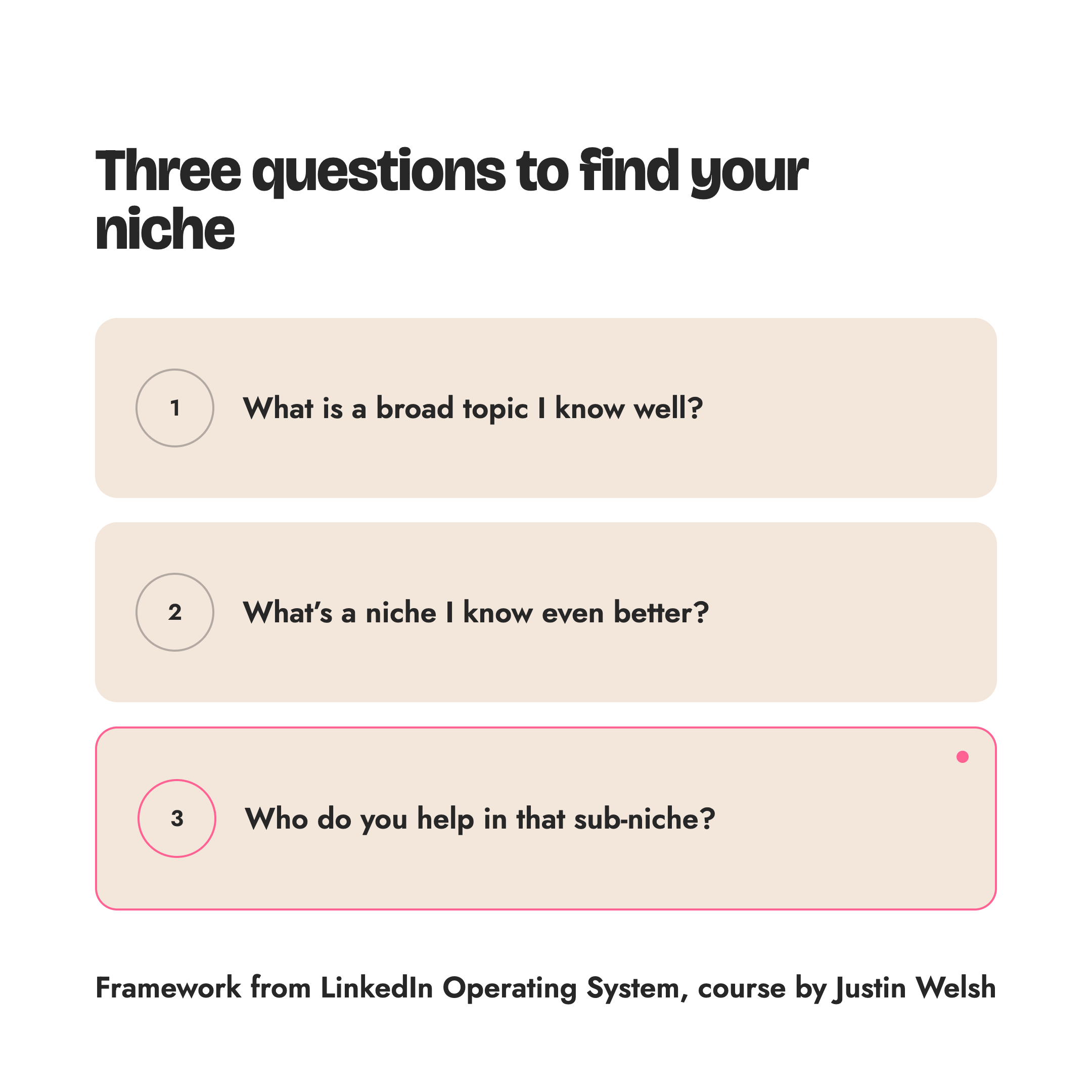
Two things I like straight away. First, he has you do this before you write a single piece of content. Niche first, content plan second. Second, he doesn’t even say ‘niche’ – he says ‘sub-niche’, which narrows it by one turn. I love that.
But look at where he arrives at who. Question three.
I think who is question one.
Here’s where the framework stopped working for me.
His first question is: what’s a broad topic you know well? And almost none of the women I work with can answer it the way it’s meant. They say ‘I don’t know it well enough.’ Or ‘I’d need to research that properly first.’ Or the other version: ‘I do know it well, and I never want to touch it again.’ The question assumes an easy, ambient confidence that most of them have never been handed. Some of that is impostor syndrome, tangled up with the whole enormous subject of women and confidence – which deserves its own letter and will get one. For now it’s enough to say: she reaches question one and stalls.
And then there’s my own version of the problem. For eight years, ‘what do you know well?’ was easy for me to answer. Learning experience design was my area of special interest, and I built a career around it. I worked as one.
But when I sat down to choose a niche to build content and a business around, I realised something uncomfortable: I knew it well, and I didn’t want it. I didn’t want to research it, or read more about it, or go any deeper than I already had. It was true, and it was useless. Knowing the subject didn’t move me one step closer to the thing I actually wanted to build.
When I first encountered this framework, my instinct was that I had to begin with what I already knew – that I had to earn the new thing by proving myself in the old one. That isn’t true.
The framework asks what you know. It can’t hear that you want to move.
The way out, funnily enough, came from the same course. Welsh lays out three ways to make content. Leading: you’re the expert, you know the material, and you bring people up to where you are – they trust you, and they buy from you. Discovering: you’re not the expert yet, but you want to be, so you read the research and share what you’re learning as you go. Reporting: you interview the people who already know. Discovering pulls knowledge from books and articles; reporting pulls it from people. And for an auDHD brain, discovering might be the whole point – the wanting to learn is the engine. When we hit a real special interest, the thing we actually want to burrow into, we’re unstoppable.
Which means you can begin before you feel ready. You don’t have to be the expert to start.
If feeling overwhelmed or anxious, try making your goal specific. Set a clear boundary, like ‘I’ll start after reading this book' or 'at fifty subscribers.' Most clients aren’t held back by being unready; they haven't defined what readiness means. Without a clear threshold, they stay in near-readiness, never starting. Setting a specific goal helps know when it's right to begin.
So I’d rearrange Welsh’s questions. I’d ask first: who would you like to help?
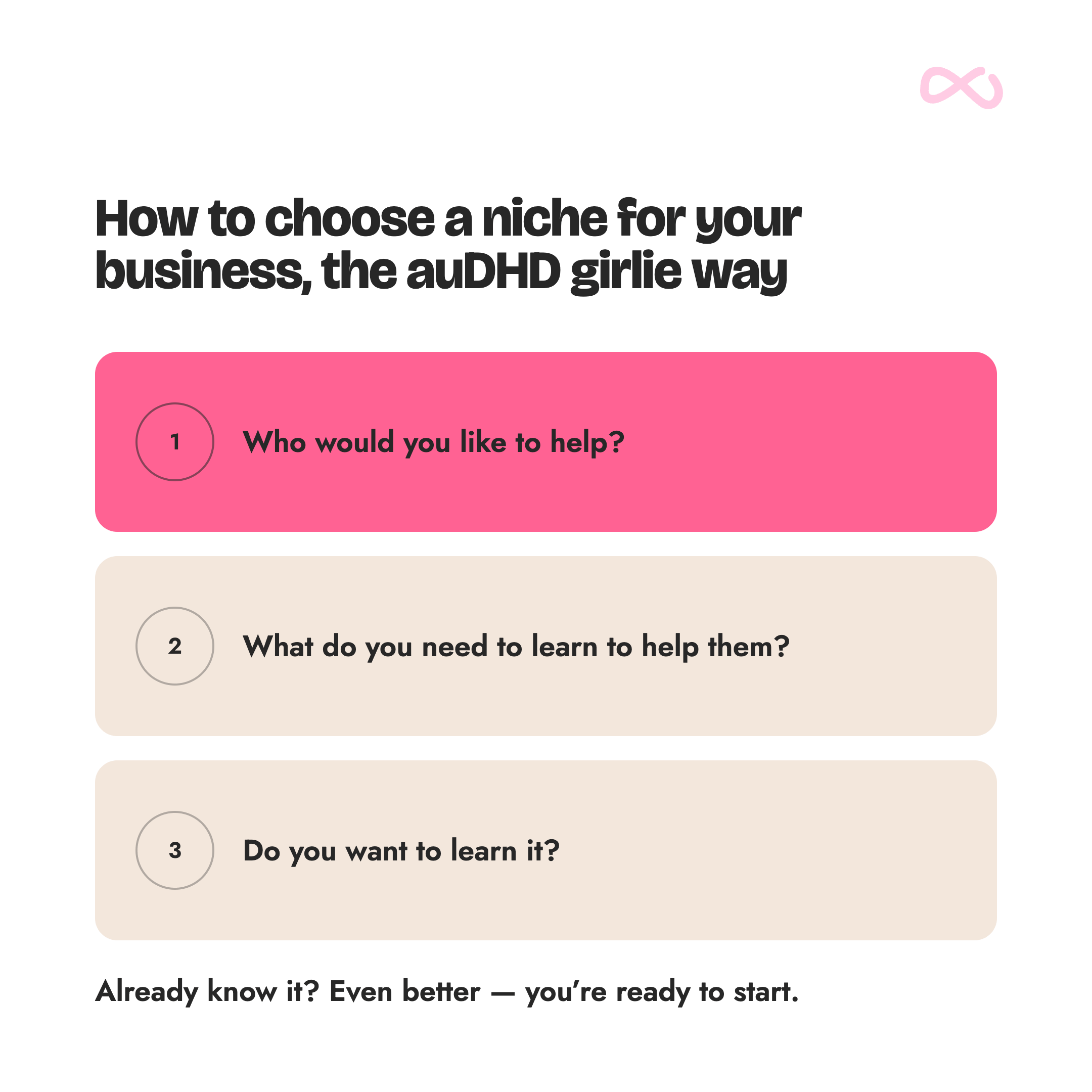
Start not with yourself, but with them. And not even with ‘them’ as an audience to sell to – forget selling for a minute – picture the actual people you’d like to help.
Two reasons this works better as the opening question. One: you probably already know the answer. Most of us want to help a previous version of ourselves. (I build for women like me.) Two: impostor feelings attach themselves to self-description. The moment you have to describe yourself, and call yourself an expert, everything seizes up. Describe the people you want to help instead, and you can suddenly talk – easily, and for as long as anyone will listen.
And there’s more than one door in. This isn’t a fixed one-two-three. Depending on the person, you might come in through: what has genuinely interested you for a long time? (Not what you know – what has stayed.) Or: what do you want to figure out?
Wherever you start, you end up in the same room: who. Say you want to go deep on the restoration of paintings. Lovely – now, who for? Students learning to restore. People who watch restoration videos to fall asleep. People studying the history of the craft. Three completely different businesses, every one of them reached by asking who.
Now you have your who. The next move is to make it more specific – which is not the same as narrower, and I’ll come back to that.
There are two things you can sharpen: the person, or the offer.
Sharpening the person, staying with hypothetical ‘teaching English’ example:
gender → English for women.
geography → English for people living in Milan.
industry and demographics → English for architecture students.
Sharpening the offer, same English:
price → intensive one-to-one immersion at the luxury end; a €15 self-paced course anyone can afford at the other.
level of quality → bespoke one-to-one coaching at the premium end; a small handmade cohort in the middle; a cheap, self-serve product at the economical end.
Price and quality are easy to confuse, so here’s the split: price is what they pay; quality is what the thing actually is. They come apart in every direction. A one-woman ceramics studio can sell handmade work at a discount. A short course, built once and sold thousands of times, is cheap to make and can still sit at a moderate price.
The interesting part is that you can combine these angles, and that’s where it gets good. My own niche is a stack of them: late-diagnosed auDHD women, already running a business, working toward earning at least €2,000 a month, reliably. That’s demographics, plus neurotype, plus a stage of business, plus a specific outcome.
But – and this is the thing to hold on to while you stack – more words are not automatically better. Specific is the goal. Obscure is the failure.
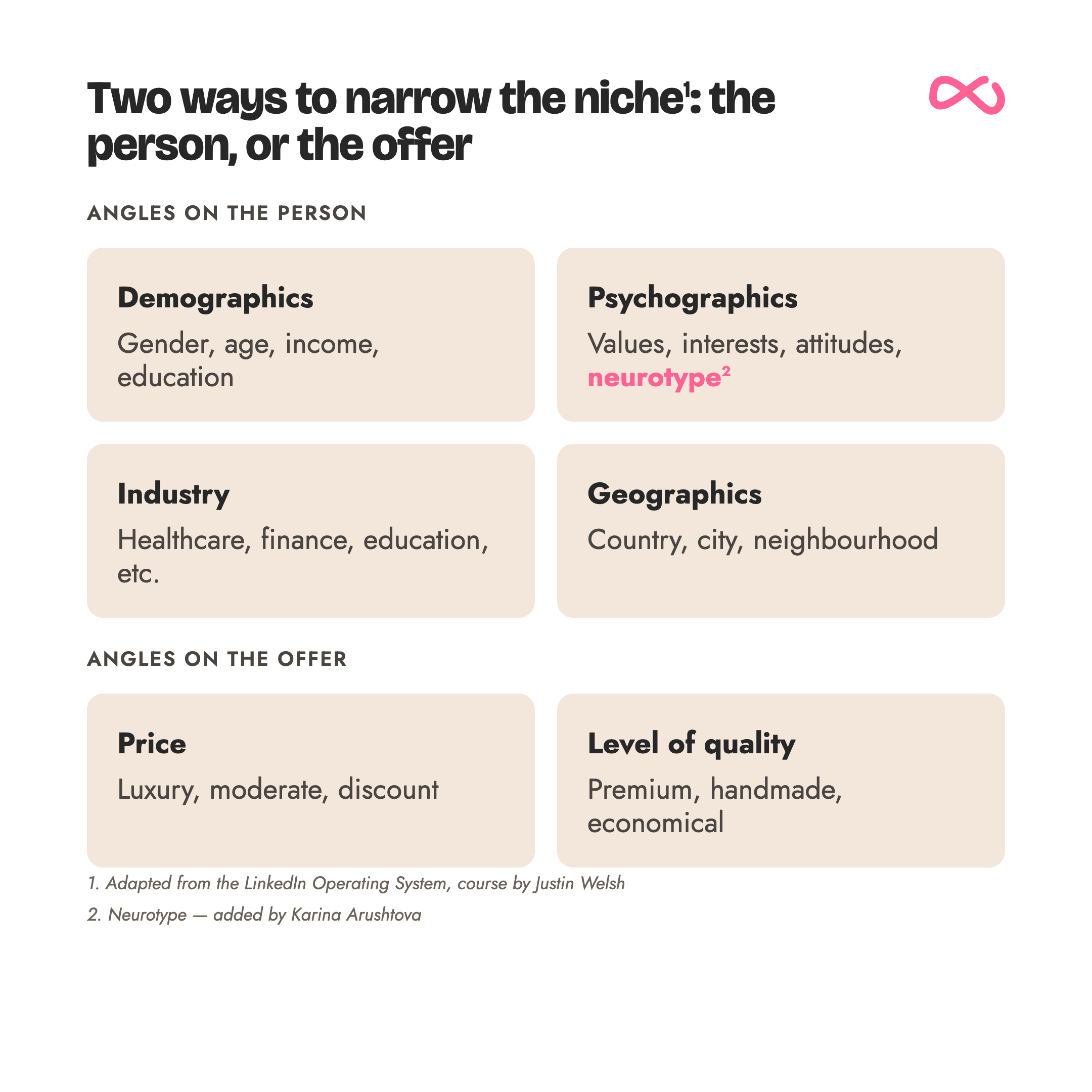
First, a warning. Every single time I’ve put that list of angles in front of a client, she’s read it as a questionnaire. Right – gender, age, income, education – and off she goes, dutifully filling in every box. Don’t. This isn’t a form to complete. Filling in every field is a different, later piece of work – it’s called an ideal customer profile, and it has its place. This list is a menu. You pick one angle to cut by. Maybe two. That’s the whole job.
And second – the specific-versus-obscure thing. Alex, who writes Neurodivergently Yours, offers a sharp example of a niche gone wrong: a business coach for left-handed, vegan, ADHD-diagnosed anarchists who run Etsy shops. It’s a funny line, and the usual explanation is that it’s simply too narrow – too few people left to sustain a business. I don’t think that’s quite it. Look at my niche again: late-diagnosed, auDHD women in business, working toward a consistent €2,000 a month. That’s a lot of words too. More, arguably.
The difference isn’t the number of words. It’s whether each word is doing anything. So here’s the test: take each word out, one at a time, and see whether anything changes. Remove ‘late-diagnosed’ from mine and the whole letter I’d write changes – the pain shifts, the tone shifts, the reader shifts. Remove ‘left-handed’ from Alex’s, and nothing moves at all. It was never telling you anything.
If a word can come out and change nothing, it was never part of the niche. That’s the line between specific and obscure.
So, to leave you with something solid – a few real sub-niches. All women. Most of them auDHD themselves. All already doing exactly this. (And notice these are sub-niches: each one narrowed a turn past the niche it sits inside.)
Ellie Kay – ADHD and auDHD coach, neurodiversity speaker, management trainer. 25,700 followers on LinkedIn.
Marie Helen Herbert – lived-experience auDHD; study-skills mentoring for ADHD, auDHD and dyslexia, alongside life, identity and menopause coaching for women. 10,602 followers.
Rebecca McCash – auDHD founder, building the future neurodivergent people dream of. 2,769 followers.
Tae Dawodu – neurodivergent career coach for women; helping you stop masking yourself into burnout at work. 2,497 followers.
Dr Sharon Zivkovic – proudly auDHD; founder of the Centre for Autistic Social Entrepreneurship.
Not one of them starts with ‘what do I know’. Every one of them starts with a who.
You don’t have to know everything before you begin. You have to choose who you’re for.